Unique Critiques

Rogue: The Paladin Prophecy Book 3

Fantasy Book Review

Fantasy Book Review

Frost continues to deliver in the third installment of the Paladin Prophecy.  Frost is the real deal when it comes to writing, having paired up with David Lynch on Twin Peaks and solo writing a bunch of novels along the lines of The Greatest Game Ever Played.  It’s hard not be interested in a writer of this caliber’s attempt at some fantasy even if it is set in a young adult world.  It’s almost like hearing Dave Chappelle is going to do Shakespeare.  Whether or not he pulls off a compelling Othello or Macbeth you sure as hell know it is going to be entertaining.

Frost takes the urban fantasy approach.  He doesn’t veer too far from the Harry Potter formula: bunch of young kids enter a school where the outrageous begins to happen.  Our main character’s parents are missing/dead and he is ushered to the school by a Hagrid like character.  Thankfully, it begins to find it’s own tune shortly thereafter.  Our main character, Will, enters school as a late add and is inserted with four other extraordinary roommates in a school so elite that almost no one knows about it.  Throughout the first two novels, each of the four roommates begin to develop powers that complement Will’s own.  Will has always been fast, but as he exercises his powers they begin to evolve and expand until he could give the Flash a run for his money.  The same holds true for the rest of his team, they’re getting significantly stronger as they mature.  In the first two novels the team is trying to understand how and why they got into this situation.

In the third, some of these answers are revealed.  Frost goes the genetics route to explain what’s behind their amazing powers.  Not so surprisingly, we find out that the genetic tampering is an offshoot from the illicit eugenics programs that the Nazis gave us pre World War II.  What is surprising and a lot more interesting are the secret societies that back the Paladin program.  Behind these secret societies lies yet another level of power, the silent brokers behind the silent societies.  Turns out our characters are smack dab in the middle of a secret war between two powerful groups that have been here for millenia.

Frost uses a couple of very cool writing techniques that brings life and relatability to his characters.  The first is Will’s rules to live by.  In the first two novels, these were written by his father and passed down to Will.  In the third novel, Will has evolved to an extent that he has learned these lessons but is mature enough and experienced enough to start writing rules of his own.  What I like about the rules is that they are a list of explicit core values that makes up the heart of who our main character is.  Core values is a term that is bandied around a lot in business but very few people actually know what it means.  Core values means that these are the ingrained values that draw lines that you will not cross.  In business, they should be serious enough that you will hire by them and fire by them.  This firing also includes customers who push you in a direction that would require you to break your core values.  Frost does a wonderful job of turning every situation our characters find themselves in to a test of Will’s core values.  While Will doesn’t always succeed in the short term he never gives up his integrity and so his core values remain sacrosanct.  In the traditional definition of the word, this is what a paladin is, one who never gives up his own integrity no matter the situation.

Frost also does a good job of managing the interplay and dialog of a lot of different characters at once.  This is tricky, with a lot of characters in the same place at the same time it is very easy to lose track of each of those characters’ personal agendas or worse, have one of these characters fade into the background and no longer contribute in a meaningful fashion.  Frost does a masterful job of weaving this delicate balance in a way that all the characters evolve around the different situations in a very natural progression.

It’s a good, fast read and well worth your while.  My only complaint with these novels is that they are not long enough.

A Tale of Light and Shadow

Fantasy Book Review

Fantasy Book Review

I first read Jacob Gowans with his Psion series and absolutely loved it.  The first book of the Light and Shadow series really struggled to hold my attention.  I normally crank through these type of books but this one took me over a week because I just kept finding better things to do than read something that is only slightly entertaining.  Don’t misunderstand, reading the book is not like going to the dentist, more like going to a family wedding.  There is some fun to be had, maybe Aunt Maureen starts to grind on one of the groomsmen who is half her age, but at the end of the day, the weekend could have been much better spent.

The story is not bad, a young carpenter by the name of Henry falls hard for a down on his luck nobleman’s daughter named Isabelle.  It turns out that the nobleman is a world class prick who puts his daughter in a situation that requires some serious rescuing.  Our carpenter enlists some friends and through a barely believable scheme he does that rescuing in epic fashion.

The rest of the book is spent on the run.  Our carpenter and his merry band get themselves into and out of a number of perilous situations that ultimately ends in a cliffhanger eagerly awaiting the next book in the series.  The plot moves forward at an OK pace, but there is nothing remotely original in it.  Gowans creates some believable tension between the characters and the situations they find themselves in but the resolution to the tension is as bland as a nutri system cookie.

The thing that bothered me most about the series is that the characters don’t ever seem to evolve until the very last scene. Both Henry and Isabelle have very little depth.  They are both kind to a fault and their relationship feels like a third grade romance.  The most interesting character is the lovable rogue Ruther and he is not that lovable and not that roguish.  What is seriously missing is a taste of the extreme.  We read books either to learn or to escape.  Sadly, this novel didn’t offer either of these things.  I will not be continuing the series.  This is one to skip.

Shattered Sea Books 1, 2 & 3

Fantasy Book Review

Fantasy Book ReviewFantasy Book ReviewFantasy Book Review

Abercrombie writes books that are damn near impossible to put down.  His style is very similar to David Gemmell’s but they have been modernized a bit to add an even darker element to every page.  Abercrombie’s characters are raw and incredibly believable.  Each one of them is uniquely forged by the fires of circumstance into something hard, dangerous and painfully relatable. I got my introduction to Abercrombie in the First Law series.  Those books were regular Greek tragedies.  When starting this series I knew not to expect happy endings but I couldn’t wait to see the trials he would throw his characters through.

I wasn’t disappointed.  Abercrombie introduces us to another cold and dark world that seemed built from the nightmares of a 13th century Viking.  In the first book we are introduced to Yarvi, the crippled son of a king.  Abercrombie shares his fascination of the disabled yet again in this character who is universally disdained by his disability in a land where survival allows for no sympathy.  The author gives you the faint hint of having his main character rise above his impediment before ruthlessly taking everything away from him.

As Yarvi’s world is destroyed and he himself is sold into slavery, the only thing he is left with is an oath of vengeance.  Luckily, to a viking, vengeance is more sustaining than a pallet of powerbars and Yarvi rises above again and again.  He makes lifelong friends of his oar-mates who respect, if not his strength, certainly his persistence and definitely his ‘deep cunning’.  Yarvi trained to be a minister which, in the Shattered Sea, is an adviser to kings.  He uses this knowledge to turn the tables on his situation and by the end he fights his way free of slavery, misconceptions and even disability.  He becomes a character that is likable and respected.

In book two, Abercrombie takes a risky approach and presents us with an entirely new cast of characters.  Yarvi is still around but he plays a secondary role to our new characters Thorn and Brand.  Thorn Bathu is a fireball.  She is one of the first women to come close to passing the warrior’s trials and she is heavily discriminated against because of it.  While these northern women are expected to fight in self defense they are never expected to become actual raiding warriors.  This bias earns Thorn a one way ticket to a personal showing of the headman’s axe.

Brand, the young warrior that Thorn bested to win her warrior’s badge, struggles with the injustice heaped upon Thorn and ultimately stands up for her, even though he can’t stand her, by bringing up the injustice to Yarvi.  Brand is one of the good guys in a bad world and he ultimately gets punished for it.

By circumstance, Yarvi takes Thorn and Brand on an epic journey to the south to gain the support of the southern empress.  They bring along a cast of interesting characters with them, one of which is an old witch that trains Thorn into a formidable weapon.  By the end of the journey, no single man seems able to best Thorn in a fight and her reality becomes legend.  Interestingly enough, a romance also blooms between Thorn and Brand in a reverse chick flick sort of way.  The relationship is as endearing as it is fleeting and you find yourself truly rooting for these two while knowing that good things just don’t last long in the dark of the North.

Our author doubles down in the third novel by changing up the cast once again.  This time our heroine is Skara, princess and daughter of a slaughtered king.  Skara is no warrior but her battles are one of policy and politics as she does her best to wrench her kingdom back from the High King.  Only she has the power to bring warring realms together to fight a greater tyrant and she does it admirably.

One of the sneaky things that Abercrombie does with his characters is turn heroes into villains.  He changes characters you love into ones that you don’t like so much along the way.  This is a much more odious and painful way of destroying characters than the Martin approach of just killing them off.  It takes a lot more balls to shift the love of a reader into something akin to hatred.  He did it with Baez in the first law and he does it again here.  Don’t want to ruin the surprise but it teaches an interesting lesson that all men are fallible when pushed in the right way.

Read the series if you are willing to give up all your free time for the next week or two.

Graceling (Graceling Ream Book 1)

Fantasy Book Review

Fantasy Book Review

As fantasy continues to push into the collective consciousness and is no longer limited to the nerdom of 20 years ago, more and more writers are flexing their literati musculature into the genre and it benefits all of us.  I wouldn’t call Kashore one of the top fantasy writers out there but she does have a lot to offer.  Graceling is well thought out, well written and smartly executed.  She builds her own world which is a must in my opinion and she populates it with interesting characters doing interesting things.  She also invents the mysticism that permeates that world and that acts as the catalyst to all major events.

The world is a fairly standard one with a handful of kingdoms, each with their own politics and beliefs which nicely sets the stage for all sorts of potential realm conflict. The people that live in this world are the staples of medieval serfdom save for the gracelings.  The gracelings are easy to spot due to their different colored eyes.  When a graceling is identified they become immediate property of the kingdom so that they can assist the dynastic lords in keeping a tight leash on the populace.  The gracelings each have a specific power that is as unique as the person themselves.  Some of these powers are completely useless but most gracelings are graced with a skill that gives them a distinct edge over the rest of the populace.

Our main character, Katsa, is one of the deadliest gracelings in the realm.  Her skill is, quite simply, death.  She spends the early part of the book as an assassin on a tether for one of the more tyrannical lords of the Seven Kingdoms.  She is not horrified by her role but neither does she revel in it.  What does horrify her is the pettiness that drives her master and she spends a good amount of the book struggling with these weak motivations.

Our other lead, Po, is a prince from one of the island kingdoms and he too is a graceling.  His grace, to the outside eye, is one of swordsmanship.  He travels to Katsa’s kingdom on a political mission with all sorts of ulterior motives and soon finds himself orbiting the same circles as Katsa.  He is as charming as Katsa is stand-offish and the two start a relationship that is as inevitable as gravity.  They start by pitting each other’s graces against one other but it soon becomes obvious that they both share the desire to be doing something relevant, something far from the pettiness of Katsa’s every day life.

Po gives Katsa the excuse she barely needs to break free from her master and set off on her own crusade.  This starts the physical journey of the fantastic which also begins the metaphysical one of self discovery.  Not only are our two characters learning about themselves but they are also learning about the graces that define them.  They discover that the graces are not the well defined boxes that others tried to put them in but instead are far more intricate reflections of their own character.

That’s really one of the main lessons that the book has to offer.  Nobody has the right to put baby in a corner.  We all have to play the cards we’re dealt but how we play those cards is entirely up to us.  As we examine those cards,. we find that they can make just about any hand we want.

The villain is a graceling as well and his motives are entirely evil.  He is the only character that could have used a little more development.  The evil he exudes is a little too anonymous and hard to identify with.  That is truly my only concern with the book.  The characters are believable and likable and the plot takes you from place to place with a breathlessness that makes you wonder how the characters will ever get out of the next pickle they are put into.  I will definitely be continuing this series.

The Extinction Cycle (Book 1, 2 & 3)

Science Fiction Book Review

Science Fiction Book ReviewScience Fiction Book ReviewScience Fiction Book Review

This is my first attempt at reading anything from Nicholas Sansbury Smith and it was enjoyable.  There is no literature in any of these pages but it’s excellent plane reading or sit by the beach fare.  Reading these books is like turning on an old Seinfeld episode that you’ve already seen.  There aren’t any surprises but you know you will be thoroughly entertained anyway.

The general premise is that some shady government jackwads decided to mix an ultimate warrior chemical cocktail with the Ebola virus to create the perfect biological weapon.  Imagine dropping the bio weapons on a terrorist group, they would turn into transformed, crazed humans that would ravage their own population, then shortly die out due to the Ebola side of it several days later.  Well, it gets out of the lab and pretty much kills the whole world.  This all happens pretty quickly in the first book.  The rest of that book and the following two deal with survival and the creation of counter bio weapons that can eliminate the monsters that were created when this escaped the lab.

The primary two characters are actually pretty well developed throughout the three books.  They’re not complex at all and our author doesn’t put them into any scenarios that would stretch them into making any deeper, more introspective decisions.  Our main protagonist is Beckham, the Delta Force badass that saw this go down from the very beginning.  He is all about survival and his competency in that category is his primary trait.  He’s as American as chocolate dipped and twice fried apple pie and you don’t see him have to make any really difficult choices throughout any of the books.  Kate Lovato is our other lead and she is the doctor that ultimately cut down the population of monsters by 90% and now has the job of creating a new weapon that will eliminate the rest of them.

Not surprisingly, because after all PhDs and Delta force typically hang out at all the same bars, these two start to hit it off and eventually add benefits to their friend status.  It is the perfect PG-13 relationship and, if not for the raging death of mankind and society around them, would feel like any other budding high school hook-up.  Maybe college, but it’s no more complex than that.  Almost all of the interactions between the main characters and others are all very black and white.  There aren’t even close to fifty shades of grey in these connections, maybe two or one, tops.

The other characters in the book have a serious case of red shirt-itis.  New characters are introduced fairly often and just as often become kibbles and bits for the rage machines outside the walls.  You can sense that Smith is doing his best to create emotional attachments to these side characters before killing them off but it’s not very effective.  Without that attachment it is pretty hard to care about these deaths so they become an abstraction that fits into the ‘holy shit the whole world is crumbling’ bucket where all the other faceless deaths live.  If he wants to add more drama, he’s gotta start killing his darlings.

He does a surprisingly thorough job with the science.  He is not quite Michael Crichton level but he’s not far off.  This was one of the things that kept me going: the science is pretty plausible.  As is the idea that a couple of chicken-hawk assholes will be the ones that take us all down in the end.

He’s also got the plot thing down pretty damn well.  You are rapidly moved from page to page as if a people walker mated with a treadmill and got stuck on high.  Never a dull moment.  Take this set of books for what they are and you will not be disappointed.

So Good They Can’t Ignore You: Why Skills Trump Passion in the Quest for Work You Love

Business Book Review

Business Book Review

In So Good They Can’t Ignore You, Newport takes one of the common American ideals that ‘following your passion’ will make you happy and completely blasts it out of the water.  The quote, ‘be so good that they can’t ignore you,’ was taken from Steve Martin who is truly one of the hardest working comedians in the business.  Martin’s point,  and Newport’s point throughout the book is that passion is actually a side effect of becoming really good at your job.  If you can develop a skill set that is rare and valuable, you are going to find that passion will become a side effect of being really good.  However, if you just follow a passion without developing any skills, you are in for a life of disappointment.  This is an excellent study into an American mythos that has caused so many people so much pain and discontent.  Newport asks and answers the questions of why is following my passion a bad idea?  If I shouldn’t follow my passion, what should I do?  How do you actually get so good they can’t ignore you?

The author takes a clinical, scientific approach to bringing his points across.  He starts with some stats that poke a serious hole in the follow your passion.  He cites a 2002 study that states that, “Less than 4% of the total identified passions had any relation to work or education, with the remaining 96% describing hobby-style interests such as sports and art.”  This bursts the passion bubble pretty quickly because if your passions are not relevant to making a living, the passion advice can rapidly become a one way ticket to destitution.  However, another survey showed that, “the strongest predictor of an assistant seeing her work as a calling was the number of years spent on the job.  In other words, the more experience and assistant had, the more likely she was to love her work.”  This was obviously just a subset of workers in the world, but this seems to touch on a universal truth, as Newport states, “Passion is a side effect of mastery”.

As he dives deeper into the issue he finds that, “the more I noticed that the passion hypothesis convinces people that somewhere there’s a magic ‘right’ job waiting for them, and that if they find it, they’ll immediately recognize that this is the work they were meant to do.  The problem, of course, is when they fail to find this certainty, bad things follow, such as chronic job-hopping and crippling self-doubt.”  He does a great job of articulating the ‘quick and easy magic pill’ zeitgeist that is rampant in our 21st century culture and goes on to show how it is slowly crushing our youth as they enter the workplace.  He argues that, “The passion hypothesis is not just wrong, it’s also dangerous.  Telling someone to ‘follow their passion’ is not just an act of innocent optimism, but potentially the foundation for a career riddled with confusion and angst.”

Up to this point, it sounds like a Shakespearean tragedy, right?  This is not true though, because there is plenty of passion to be found, it just takes hard work.  Throughout the book, Newport introduces us to a number of different successful people and asks the questions of, how did it work for you?  Universally, the answer is almost always the same, become really good at what you do, or in Martin’s quote, “Become so good they can’t ignore you,”.  Newport calls the hard work approach the craftsman mindset.  This is in strict contrast to the passion mindset.  The “craftsman mindset focuses on what you can offer the world, the passion mindset focuses instead on what the world can offer you.”  One focuses on the value you bring, where the other is a sense of first world entitlement.  Or as Newport puts it, “No one owes you a great career…you need to earn it – and the process won’t be easy.”

So how do you earn it?  This is where Newport introduces the idea of career capital.  You build career capital by tons and tons of deliberate practice.  Deliberate practice goes back to the 10,000 hours magic number that Malcolm Gladwell made the focus of his book Outliers.  The problem is that deliberate practice is very different from just showing up and working hard, “if you just show up and work hard, you’ll soon hit a performance plateau beyond which you fail to get any better.”  Deliberate practice is not the fun stuff that you are comfortable with, it is getting outside of your comfort zone and stretching yourself to get better.  That’s why people hate to do it because it is not fun but it is also the key to becoming excellent.

Newport moves into other concepts in the book, like the importance of having a mission but I derived the most value out of the career capital idea.  This concept of deliberate practice is not new.  What I’ve always struggled with is how to actually put it into practice.  If you are learning an instrument or picking up a new sport, the blueprints of practice are somewhat obvious especially if you have a good teacher.  But what if you’re a VP of a software development firm, or a manager of a sales organization?  How do you deliberately practice those skills?

The author provides some tips here too by sharing his practice routines: “Once a week I require myself to summarize in my ‘research bible’ a paper I think might be relevant to my research.  This summary must include a description of the result, how it compares to previous work, and the main strategies used to obtain it.”  He also shares his Hour-Tally Routine. “Another deliberate-practice routine was the introduction of my hour tally – a sheet of paper I mounted behind my desk at MIT…The sheet has a row for each month on which I keep a tally of the total number of hours I’ve spent that month in a state of deliberate practice.”  He also spends a good amount of time brainstorming new theory results, “at the end of each of these brainstorming sessions I require myself to formally record the results, by hand, on a dated page.”

The conclusion I drew is that deliberate practice techniques can be found no matter what your discipline, but you do need to define them for yourself.  I plan on doing that very thing and seeing if I can bring more deliberate practice into my day to day work to continue to become ‘so good they can’t ignore me.’

Uprooted

Fantasy Book Review

Fantasy Book Review

Novik wrote an interesting novel that puts nature in the villain seat.  My previous experience with Novik is with her Temeraire series which is a fascinating concept of dragons playing the role of transportation and vessels in an alternate reality that drew strong parallels to the British navy in and around the Napoleonic Wars.  It was like Horatio Hornblower with scales and flamethrowers.  While the concept was great, I wasn’t a huge fan of the writing.  I remember long run-on sentences with over-the-top Dickensian attention to description and detail that just got boring.  I’m happy to say, in Uprooted, she got way better at her craft.

Novik introduces us to Agnieszka in the first chapter. She is a rough and tumble girl who’s only talent seems to be getting filthy.  They live in a rural little hamlet that is at the base of the Wood and the Dragon’s tower.  The Dragon in this novel is a wizard by the name of Sarkan and he takes a girl from this little village as tribute once every ten years or so.  Agnieszka is this year’s tribute.

Our protagonist quickly finds out that she is a witch, much to the surprise of our wizard, who grudgingly accepts the role of teacher and mentor.  The Dragon’s style in magic is as fastidious and pretentious as the man himself and it does not blend well with the dirty and free nature of young Agnieszka and they clash at almost every turn.  Finally, our heroine finds a text from an old hedge witch that teaches magic in free form that resonates far better with her and she starts to find her power.  The magic style drew some neat parallels to music.  The Dragon’s style is powerful but rigid, much like a classically taught pianist where Agnieszka’s is very free and wild more jazz and blues requiring heavy doses of improvisation.  When they finally figure out how to tie the two styles together, they create a symphony of wonder that is truly fun to read.

While our two main characters do get embroiled in the politics of the land, the villain and the cause of all the strife is the Wood that stands at their doorstep.  The Wood is corruption.  It is populated with creatures that have been morphed into dangerous, tainted killers.  Worse, the Wood has the power to corrupt humans that stray too far within.  When these people are taken, they come back with an abundance of charm but nothing but evil and death in their hearts.  It reminded me of getting buried in the Pet Sematary: “First I played with Judd, then mommy came and I played with mommy.  We play daddy, we had awful good time.  Now I want to play with you…”  Yeah, don’t go into the Wood.

Our characters find that together their powers can fight the corruption of the Wood.  They are the first to be able to do so in many years.  The characters are very believable and you find yourself rooting for them throughout.  The world Novik creates is a throwback to the darkness of the old Grimm fairy tales but with much more depth.  She assumes a maturity in her readers that is much appreciated.  It’s a great book.

Get a Grip: An Entrepreneurial Fable…Your Journey to Get Real, Get Simple, and Get Results

Business Book Review

Business Book Review

Wickman and Paton wrote a business book that reads like a novel.  In this business novel, they introduce what they call the entrepreneurial operating system via a fable about a struggling services company that is on the daily brink of implosion.  This company is talked into hiring a consultant that comes in and turns the ship around using this EOS system.  The story is just a medium for passing on a wealth of business knowledge, which you can also get from the companion book, Traction: Get a grip on your Business which, from what I understand comes sans story.  There is a lot of excellent advice within these pages but what I found most useful about the book is that it provides a complete system to running a business well.  This is a stark contrast from most books in the genre which typically focus on only one aspect of the business or in many cases one person’s opinion on one aspect of the business.  This book lays the framework that not only gives you the whole enchilada but teaches you how to cook it.

Our consultant arrives for the first meeting amid a fair amount of skepticism that he begins to dispel through a series of pointed question that gets to the heart of why this company is floundering.  The topics that he brings up are universal to most businesses which is what makes the fable approach relevant in the first place.  The first question he asks is: how effective are your internal meetings?  The second, how aligned is the entire organization around your plan?  The third: how would you rate the level of accountability that exists in your organization?  As you can imagine, the team in the fable does just as poorly as most businesses do on these three questions.  This set of questions opened the door to looking at the six key components of any business, VISION, PEOPLE, DATA, ISSUES, PROCESS AND TRACTION.  The authors then go into describing each of these in a bit more detail, but the one they spent the most time on was the people aspect.  They used a Jim Collins quote who emphasized, “that to succeed in business, you need to have the right people in the right seats.”  They then got into defining what this actually means, “Right people share your Core Values – they fit your culture.  Right seats mean everyone has the skills and experience to excel in a job that’s truly important to your organization.”  This led them into the accountability chart which is a really a “supercharged org chart because it absolutely crystallizes everyone’s roles and responsibilities.  It establishes clear ownership of and accountability for everything that’s important to your business and plainly illustrates who reports to whom.”

Another one of the underlying themes throughout this book is similar to what we saw in Creativity Inc., one of the keys to success is candor or as these authors describe it, open and honest.  In their words, “Open means both open with one another and open-minded.  When somebody else on the team has something to say, you don’t have to agree, but you do need to hear it, so we can consider everyone’s perspective,.  Honest means just say it.  We can’t deal with an issue unless we get it out of your heads and on the table.”  Along this same vein, this brought our fictional team into analyzing their own roles and accountabilities using what our authors call the GWC approach. “GWC stands for ‘gets it, wants it, and capacity to do it’.  When someone gets it their brain is innately hardwired in a way that matches the demands of the five roles in their seat.  When someone wants it, they genuinely spring out of bed every day – wanting to excel in their roles.  And when someone has the capacity to do it, they have acquired the intellectual and emotional maturity, education, training and on-the-job experience to consistently perform well in the seat.” This team then went through a very painful exercise of asking the entire team if they all GWCd their own seats.  They also make a great point about accountability, “You can’t have two people accountable for a single major function…because when two people are accountable, nobody is accountable.”

Our fictional team then started to get into the heart of getting stuff done.  They listed out all of their big ‘rocks’ or those things that were important to deal with in the team and their consultant led them through a stimulating session of ‘keep, kill and combine’ to prioritize the ones that had to be dealt with first.  He also throws a warning out there that all rocks that folks were signing up for had to be, “SMART – specific, measurable, attainable, realistic, and timely.”  This turned into a quarterly rock sheet that would be reported on in their level 10 meeting every week.  The concept of the level 10 meeting was another good one, these are very directed meetings focused on solving real problems following the EOS methodologies.  The level 10 comes from making sure each meeting is rated a 10 in the last 5 minutes at the end of each meeting.  He put forth a strong agenda for these meetings: Segue (good news – personal and biz), scorecard review, rock review, customer and employee headlines, to do list, IDS (Issues list), conclude (recap to dos, cascading messages, rating 1-10).  The key to most of these was that everything but the IDS is a 5 minute task, if something is off track you drop it down to the issues list and deal with it there.  IDS stand for identify, discuss and solve and this is the core of productive meetings, solving these issues for good rather than circling around them again and again and never coming to a conclusion.  To make these level 10 meetings as effective as possible, he also called out timeliness.  These things have to become a high priority and the leadership team needs to treat them that way.  Our authors even used a Lombardi quote stating that if your on time, you’re late.  Everyone needs to come to these meetings prepared, early and ready to work.

They got deeper into personnel issues next.  The challenge they gave themselves was discovering their own Core Values.  He asked them to start this process by first calling out the superstars in the organization, those people that really fit the culture and if you had more of them you could conquer the world.  He calls out the most important core values as the, “Permission to play Core Values are traits essential to this organization.  You will never hire someone without these traits, and you’ll ask people to leave the organization when you learn they don’t possess them.”  Our consultant segues from Core Values to Core Focus, “Core Values define who you are, Core Focus defines what you are…your 10-year Target is where you’re going.  It’s a long range, energizing goal that everyone will rally around.”  The tool that I liked the best that came out of this was the people analyzer.  The people analyzer asked the leadership team or just the manager to directly compare employees to their core values.  In our fictional team’s example this was five values and if the person is below the bar on any of those five values, they get their strike one meeting.  The employee gets a very candid review of where they are below the bar and what they need to do to change.  If they get to three strikes, they are let go.

They go on into more strategic elements next of the three year plan, the one year plan and the quarterly check ups.  What I enjoyed most about all of these tools is that they are well defined and not just abstract concepts.  The authors give you a set of blueprints that you need to fill in on your own taking you to a much stronger business.

Well worth the read.  I heard about the book from an advisory board that I sit on and several of the CEOs there swear by it.  These are big players and if it can help their business, it can probably help yours too.  My plan is to move on to the companion novel, Traction, next.

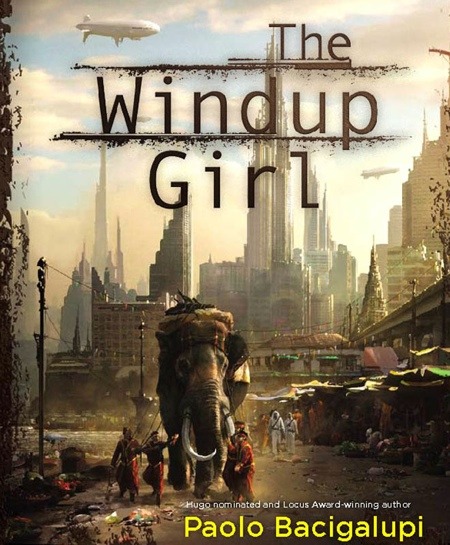
The Windup Girl

Science Fiction Book Review

Science Fiction Book Review

Paolo Bacigalupi wrote a beautiful but painfully brutal novel set in a dystopian future Thailand.  The writing is excellent but in a detached, scientific sort of way.  The characters are difficult to connect with but I think that is the point.  This is a future without food so the rules have changed back to survival of the fittest where relationships are made in a far more pragmatic way than in a world of excess.  The novel is a warning but not one that is as obvious as the cudgel used in An inconvenient truth.  All of the characters have long accepted that man has already seriously fucked up the earth and are now just trying to make their way within it.  This is much more of a study of the human condition under extreme stress than anything else.  Our generation is one without great world wars, so that is not an outlet to conveniently place our characters within to see how they react, instead Bacigalupi is forced to manufacture a setting where such extremes do exist.  It’s not pretty but it is gripping.

The novel doesn’t fit into any specific genre but that is part of it’s allure.  It’s got high technology elements to it in the form of the gorgeous windup girls that are supposedly little more than garish, Japanese sex toys.  It has elements of steam punk to it with its dirigibles and hand cranked CPUs.  It also has a bit of historical precedent to it, the riots and those that perpetrated them had a very Boxer Rebellion feel to them.  But most of all, it is dark and very brooding.

To set some context, the world has gone through tough times.  Genetically modified plants have created genetically modified diseases that have wiped out most plants to the point where almost all of the world’s food supply has been eliminated.  What does still exist of the food supply are seed banks that are jealously guarded by global conglomerates doing anything they can to stay one step ahead of the mutations of the diseases that will ultimately wipe the seeds and humanity out.  This leads these mega corporations to constantly be looking for new ways to expand their own stock to something that might permanently stay ahead of the disease curve and pull them out of this morass that their fore-bearers (us) created for them.

That leads us to follow one of these conglomerate’s agents in Thailand where he is looking for new seeds, new plants and something to help in this battle against hunger.  What he really seems to be looking for is hope in a world that is in very short supply.  He has several projects he is working through where he is forced to deal with the mundane bureaucracy of an Asian populace that is short on patience.  While he is navigating these waters, a storm of discontent fueled mostly by resentment over the loss of power and national identity is brewing within the local populace.  Things get out of hand and his mission turns into one of short term survival which quickly supersedes the global mission of long term survival.

Throughout the story we are introduced to the windup girl.  The windups are automatons that were built sometime ago when luxury was commodity.  They are very lifelike but were given herky-jerky movements to differentiate them from a crowd of humans.  The logical fear was that with this technology they could easily be used as assassins or super soldiers so adding this artifice would at least make it easier to see them coming.  In this futuristic Thailand, the windups are treated with disgust and paraded about almost like sideshow freaks.  Perhaps this is a resentment of technology that brought us to this sorry state or simply the human need to feel like we are superior to other sentient beings.  Whatever it is, the discrimination is palpable and painful to read.  In the end, her story is just another story of oppression but no less interesting because of it.

These two characters and many others intersect throughout in a stew of simmering anger and pain with a garnish of malaise that makes for some good eatin’.  Not the easiest read but it makes you think and I finished the book a changed person.  Can you ask for anything more from words on a page?

How to Bake Pi: An Edible Exploration of the Mathematics of Mathematics

Math and Science Book Review

Math and Science Book Review

Eugenia Cheng takes on the ambitious task of trying to bring the excitement of math to the lay person through the study of category theory.  This is a long shot that requires truckloads of metaphors.  Luckily, she has a deft hand at metaphor and she does an admirable job of bringing her excitement about the subject matter to the page.  She starts simple with, “Mathematics is the study of anything that obeys the rules of logic, using the rules of logic.”  For you Vulcans out there, this means that math can study damn near anything, except for maybe teenage girls.  One of the really cool aspects of math is that it is based on that very simple premise, math can take us to crazy new places.  Another one of her great metaphors, “Do you know that feeling of climbing to the top of a hill, only to find that you can now see all the higher hills beyond it?  Math is like that too.  The more it progresses, the more things it comes up with to study.”  This certainly brings to mind an internal exploration of logic and reason that can seem almost limitless in it’s scope and breadth.  As long as you have the tools, there really are no limits to where math can take you and that really is exciting.

Two of the major tools to start this exploration are abstraction and generalization.  Abstraction begs the budding mathematician to ignore some details so that the situation becomes easier to understand.  In Cheng’s words, “Abstraction is like preparing to cook something and putting away the equipment and ingredients that you don’t need for this recipe, so that your kitchen is less cluttered.  it is the process of putting away the ideas you don’t need for the present purposes, so that your brain is less cluttered.”  She goes on to acknowledge that abstraction is also dangerous and where we lose a lot of people in the weeds.  “Abstraction is the key to understanding what mathematics is.  Abstraction is also at the heart of why mathematics can seem removed from ‘real life’.  That detachment from reality is where math derives its strength, but also its limitations.”  She emphasizes that one of the keys to the mathematical method is being very clear about your assumptions.  This reminded me a lot of Nate Silver’s book, The Signal and The Noise, that dove deep into mathematical modeling.  One of his major premises was that mathematical models need sunlight shone on their assumptions from the very beginning to be successful.  You can tell that Cheng loves the process of abstraction because it opens up so many crazy doors, “Part of the process of abstraction is like using your imagination.  Mathematical abstraction takes us into an imaginary world where anything is possible as long is it’s not contradictory.  Can you imagine transparent Lego blocks?…Four dimensional Lego blocks?  Invisible Lego blocks?”

Before she dives into generalization she spends some time on mathematical rigor.  This is another area where I, as a physics major, always had a problem with math in school, mathematicians seemed to get all tied up in the minutia of the process which, in my mind, didn’t relate to the real world.  Cheng poses that math really is all about the process and that’s what makes it interesting, “Math is a world in which the end does not justify the means: quite the reverse.  The means justify the end; That’s the whole reason it’s there.  It’s called mathematical proof,…”  I’m starting to come around.

Generalization is the other major tool in a mathematicians toolbox.  “This is the point of generalization in mathematics as well – you start with a familiar situation, and you modify it a bit so that it can become useful in more situations.  It’s called generalization because it makes a concept more general, so that the notion of ‘cake’ can encompass some other things that aren’t exactly a cakes but are close.”

With these tools, imagination starts to become a mathematician’s friend.  “The key in math is that things exist as soon as you imagine them, as long as they don’t cause a contradiction….Do you think it’s cheating to solve a problem by inventing a whole new concept and declaring it to be the answer?  For me this is one of the most exciting aspects of math.  As long as your new idea doesn’t cause a contradiction, you are free to invent it.”  How many art majors would have become mathematicians with a teacher like Cheng?  It’s a shame that we teach math in this painful, rote methodology that squeezes all of the excitement out of what rigor and logic have to offer.  Math has been called a lot of things, but creative is rarely one of those things.  How do we bring this excitement back to the classroom?

She never gets into the nitty gritty of category theory, but instead she alludes to it through many different examples.  Here is one of them, “Whatever mathematics does to the world, category theory does for mathematics.  It’s a sort of meta-mathematics like Lego Lego…Category theory is also an organizing principle, just one that operates inside the world of mathematics.  It serves to organize mathematics.”  I never truly understood category theory from the book, just that it is worth looking into in more detail.

I thoroughly enjoyed reading the book, especially the actually mathematical examples that took me out of my comfort zone.  Those things that make you think beyond what you can see are what seem to bring true knowledge and this book is full of those things.  Overall though, it’s her joy of the subject matter that makes the book work.  It’s worth your while.

Post Navigation