Unique Critiques

The Lost Command (Lost Starship Series Book 2)

Science Fiction Book Review

Science Fiction Book Review

This series is my first attempt at reading anything by Heppner but I don’t think it will be the last.  It’s easy reading that doesn’t ask the brain to stretch too deep into pondering life questions but for the quick getaway, this is a good series.  Like a lot of modern sci-fi, Heppner makes no attempt at going deep into the science.  Much of it is just assumed and recognized as something that will all be figured out by the time we hit that point in the future.  He does pay a a campy homage to one of the old sci-fi guard, Keith Laumer, in naming the wormhole-like travel after him with his Laumer-Points.  The science is not a necessity to the story though, and the story is a good one.

Since this is the second novel in the Lost Starship series it’s worth spending a minute to set the stage.  In the first round, our author introduces us to Captain Maddox, an intelligence officer with preternatural intelligence and reflexes.  He’s good at his job and because of that, his mentor the Iron Lady (who in my mind’s eye I see being played by Judi Dench in the movie version), takes him way out of his comfort zone and sends him on a mission to find the Lost Starship.  Dun duh dun.  The reasons are hazy at first but become clearer throughout the novel as we find that there is a new threat to humanity in the form of the New Men.  The New Men evolved from a colony of eugenicists right out of some Eichmann wet dream.  The group went on a space walkabout several hundred years ago and ended up on a distant rock in a distant galaxy.  They got to work on their embryonic alchemy and several hundred years later, they are making their way back to the Commonwealth to stir up trouble as the new supercharged Aryan bungholes.  Cool idea.

Maddox is tasked with putting together a team to go find this lost starship that has superior technology from another space faring race that existed back when we were still planting crop for the first time in the fertile crescent.  This technology is meant to give us the edge in the upcoming confrontation with the New Men.  Maddox goes out and builds a made for TV crew that have all the qualities you’d expect in building some drama.  There’s the rule following starship lieutenant that was brought up on the tough streets of Detroit, there’s the fighter pilot ace with a drinking problem, the brilliant doctor with an attitude and the sexy yet incredibly tough mechanic/muscle.

No surprises with the supporting cast.  Sadly, they were too predictable and a little two dimensional for my tastes.  Each character seemed to have one strength and one weakness.   It was like Heppner went to the sci-fi attribute wheel, let it spin, and picked one good trait and one bad for each.  He spends some time developing each of these characters in both novels but unfortunately they never get much more depth.  Maddox, our main character, on the other hand is an interesting character bit in a bit of a humble braggy way.  The flaws built into Maddox are not really character flaws but more from his mysterious genetic background.  This is interesting but at the same time a bit of a cop out.  Flawed characters are always more identifiable because of the flaws in ourselves.  At the same time, it requires a certain vulnerability from the author that the greats are comfortable with but with which others struggle.

In the second novel, our team has successfully found and turned over the lost starship, the Commonwealth has had their first skirmishes with the New Men and have been soundly routed and our heroes from the first novel have moved on to bigger and better things.  The book opens with a major battle with the New Men in which the Commonwealth gets their asses kicked once again.  This results in another call to Maddox to come in and save the day.  The lost starship stopped communicating with the governmental bureaucrats mainly because they are governmental bureaucrats, go figure, and Maddox is given the mission of not only cleaning up the mess but trying to bail out the survivors of the first round of the Commonwealth’s Alamo.

This second installment has a little more spy craft in it, a little less character development but a lot of fun plot lines and teamwork between the major players.  Heppner does a good job of keeping you riveted but not the best job of making the story memorable.  It’s catchy escapism and well worth the read and I will absolutely buy the third novel in the series.

Trysmoon Book 4: Sacrifice (The Trysmoon Saga)

Fantasy Book Review

Fantasy Book Review

I did a previous review on the first book of this series and have waited until completing the last to do a final review.  I was incredibly impressed with the first book.  One of my big concerns in the first review was how powerful the primary protagonist, Gen, became and the heights he achieved early in the series.  This often becomes a big barrier to keeping the story interesting as the plot progress.  Fuller answered that challenge nicely by continuously throwing our hero under the bus both in matters of destiny and matters of the heart.

Any good series like this is always built first on the solid foundation of character development by using the relationships these characters have with each other.  This saga was rich with these.  One of the more interesting relationships was the love triangle between Gen, the Chalaine and the Chalaine’s mother, Mirelle.  This was something right out of any college kid’s fantasy.  Mirelle makes no excuses for trying to Mrs. Robinson her way into Gen’s pants.  She is obviously one of the hottest milfs out there so, really, she provides an ethical dilemma that only one of Gen’s character and dedication can manage to navigate through without giving up his own ethical compass.  This achievement is made even more extraordinary when you consider that the Chalaine is not giving up the goods in the first place.  This borders a little on the unbelievable until you make the conscious decision to just roll with it and accept it as part of the fantasy.

The relationship with the Chertanne is also an enjoyable one.  The Chertanne is the character that is supposed to be the savior and focus of the prophesy that bails mankind out of the upcoming apocalyptically bad time floating just over the horizon.  You learn, even in the first book, that he is nothing but an entitled little prick.  The slightly unbelievable thing about this character is his inability to evolve into someone with even one iota of likability. This is true even after he gets sent, quite literally, to hell.  The interesting thing about the relationship between Gen and the Chertanne is that Gen does a wonderful job of turning almost everyone with a shred of common sense against the personality failures of the Chertanne simply by being the polar opposite in both deed and word.  This is incredibly satisfying but a little naively idealistic when one considers the current breed of politician we are forced to stomach in our real world that thrive in a system that doesn’t seem to be able to hold any of these entitled pricks accountable.  I guess that’s why we read this type of fiction in the first place.

There are misses on the relationship side as well though.  I think the biggest miss is the relationship between Gen and his former mentor/tormentor the Shadan, Torbrand.  The Shadan is the ruthless lunatic that gave Gen his training and resistance to pain by keeping the threat of his friends lives over his head as he treated him like a practice dummy.  However, when the odds are against both of these gentlemen in a desperate last stand, they act like BFFs once removed without any of the former antagonism that should rightly exist.  I know Gen is the forgiving type, but come on.  There are other misses along the way too like the Dason relationship and the non factor that Gen’s former flame becomes as the book progresses but none of these are significant enough to make the story un-enjoyable.

The plot charges forward nicely throughout the entire series with only a couple of lulls where it looks like Fuller is looking for something for the characters to do.  But again, these aren’t enough of a slowdown to keep you moving with the characters.  The twists that Fuller continues to add to the prophetic paradigm as he twists the prophecy into something much more dynamic are well worth the read.  This makes the too simple good vs. evil dynamic much more interesting.  The closing chapters are also satisfying as the Fuller wraps up the closing lines of the prophecy as well as turning the love triangle into more of a straight line.

All in all, a good series well worth the time investment.

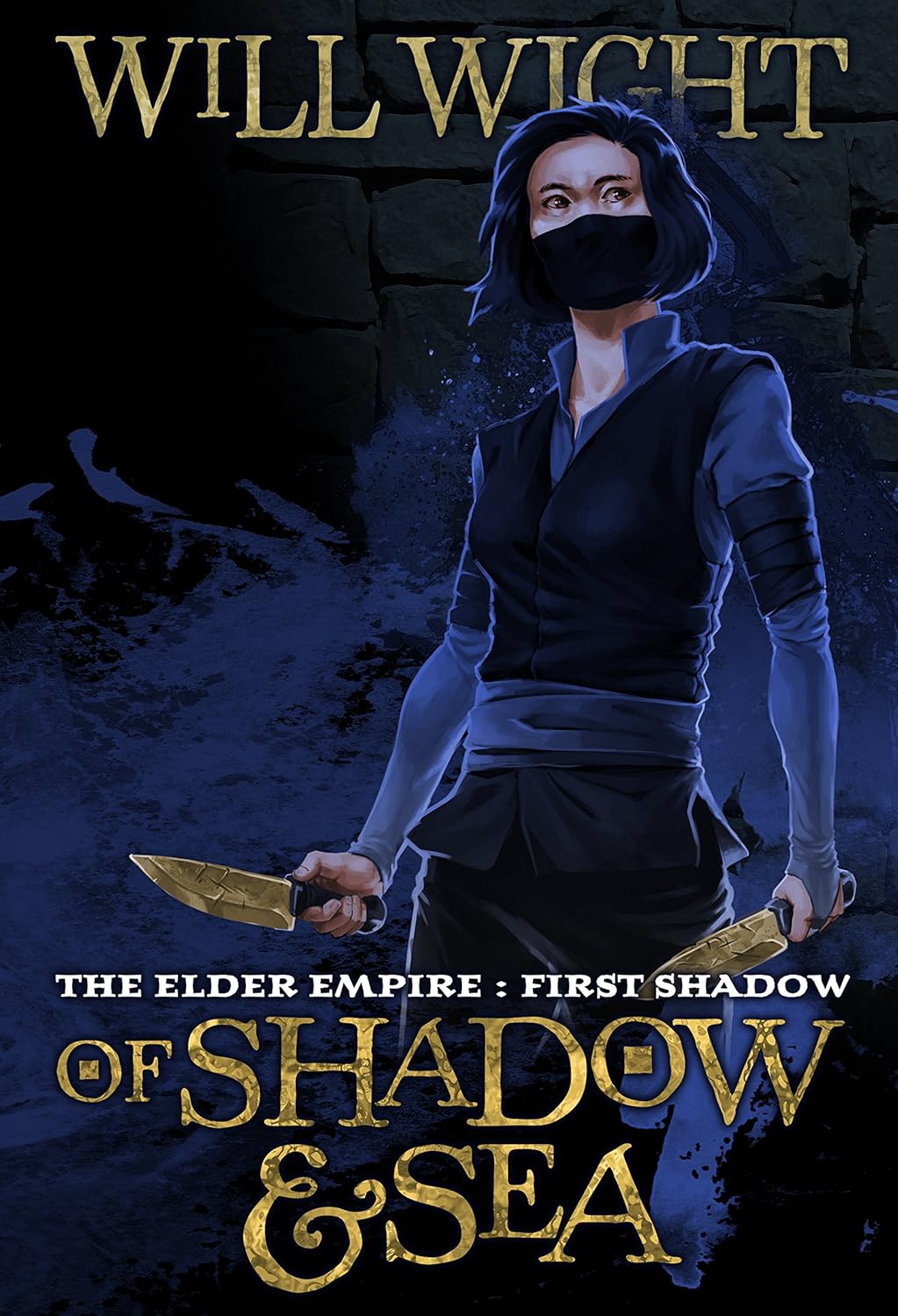
Of Shadow & Sea (The Elder Empire: First Shadow)

This is really just a continuation of the previous review.  Of Shadow & Sea is the sister novel to of Sea & Shadow and it’s very obvious that Will Wight shines much brighter when he’s in the dark.  Just like in the Traveler’s Gate trilogy, the dark characters in this novel are much more interesting.  Calder Marten has his moments as the lovable rogue but you never see the complexity experienced by those that grow up in Shadow.  The back stories are more interesting, the subplots are more engrossing and the interplay between the characters seems more genuine and feels like there is more at stake for each of them.

Granted, this may all be because I was already introduced to the world by the sister novel and so didn’t have to multitask between understanding new concepts while gradually getting to know the characters.  But I don’t think that’s it.  I think that Wight likes these characters more because they are counter culture and the life of an assassin clearly floats his boat more than, well, an intrepid seaman.

Our main character in the book is Shera.  Shera never had an easy life.  We are introduced to her as a young street thug.  On the streets, she is the ultimate survivor in that ruthless killing doesn’t seem to phase her one bit.  I spent much of the novel wondering if her complete lack of empathy was a survival mechanism or some form of autism or flat out psychopathy.  One of her less endearing characteristics is that she can and will fall asleep at any opportunity.  I found this a little annoying at first but as the book evolved, I believe that this constant semi-narcolepsy was really her escape mechanism.

While the author does not dive too deeply in to the messed up psychology of a trained killer, he also doesn’t shy away from it.  We often find ourselves right there with Shera as she is asking herself ‘why don’t I feel bad about doing these terrible things?’.  These are the right questions, the hard questions that bring about a true connection with the reader.  None of these emotions are resolved in the first book and near the end there is obvious foreshadowing that the complexity of these interactions is just going to grow.  That’s a good thing.

Shera’s supporting cast is much better developed than Calder’s.  I care much more about what happens to Meia and Lucan than I ever did about Calder’s crew.  Calder’s crew were more photographic archetypes, who looked like they had depth at a distance but we never got the pleasure to cross the velvet line and look at em up close to see the cracks and blemishes that make art all the more interesting.  Meia and Lucan were also deeply flawed characters and I mean that in the most complementary way.  Flaws open the door for conflict and all good books need conflict to keep you engaged.  That’s part of the reason why the interplay between this threesome is interesting and natural.

I also got the pleasure of knowing what was going to happen at the end of the novel but experiencing it from a different viewpoint.  This is risky because if the reader knows what is going to happen at the end, you may lose them early.  The risk pays off though because you get to understand how perspective makes all the difference in any story.  Whether in real life or fiction, perspective makes the same story feel totally new.

Looking forward to the next books.

Of Sea & Shadow (The Elder Empire: Sea Book 1)


I first encountered Will Wight’s work in his City of Light series.  In that series I was blown away by how he completely changed the dynamic of yet another young hero that needs to fulfill a prophecy.  He decided to instead focus not on the hero of the prophecy but one of his lesser known friends who turned out to be a hell of a lot more interesting than the two dimensional ‘hero’.  In Of Sea & Shadow, Wight continues to experiment.  He released two books at the same time Of Sea & Shadow and its companion Of Shadow & Sea.  He warns that these two books tell essentially the same story but from a different character’s point of view.  This reminds me of Card’s novel Shadow of the Hegemon which retold the Ender’s Game story from Bean’s point of view.  Sounded boring at first blush but turned out to be brilliant.

I’ve only just begun the companion novel, Of Shadow & Sea,  so this review will focus solely on the lighter side.  Wight respects the intelligence of the reader by asking a lot from them.  His world building tosses the reader right into the mix without introducing any of the terms or concepts that are meant to be commonplace in the prose and then slowly filling these terms in as the plot progresses.  This has always been an enjoyable way to ease into a new world, almost like learning a new science or programming language.  Some elements you have to take on faith early on that you will understand later as you gain more experience in the world.

This one has a little extra challenge associated with it due to the grand experiment Will Wight has taken on.    The extra challenge is that you know that you are not going to get any of the extra tidbits until you start reading the companion novel.  Just reading one of the books is almost like doing a Sudoku puzzle without using any 4s or 7s.  You know that there are going to be gaps but is it still enjoyable?

Luckily, it is.  Wight always does a great job of characterization, you end up really caring about what happens to his characters, and when you’re done you feel like these folks could have been a part of your past.  I did struggle a little bit more with these characters than with previous novels due to some of the gaps but I found myself looking forward to seeing how they would be filled in deeper in the next novel.  I also had a good time guessing who would be the main character in the next novel.

On to the plot.  The novel introduces you quickly to the swashbuckling protagonist, Calder Marten.  Calder is the captain of a large ship with a very small crew.  The reason for the small crew is that Calder is a Reader that is intimately linked to his ship.  The ship is an extension of his mind and he can control sails and rigging like just another appendage. Wasn’t super clear on how the crew sailed the ship when he was sleeping but little details like that don’t take away from the enjoyment of the book.

The world is run by Guilds that each have some level of mystical prowess.  Calder is part of the Navigator’s guild but he was raised as part of the Blackwatch.  The Blackwatch monitor Elder activity.  The Elders are the supernatural beings that populate the depths of the world.  You don’t want to run into these guys on a vacation because you’re pretty much guaranteed to have a bad time.  The world itself is an Empire run by an Emperor who has recently passed on.  The ambient power struggles that Calder finds himself in are around the Guilds trying to decide who should take on the burden of leadership left by the void of the recently deceased Emperor.

Calder takes on a couple of passengers that belong to the Watchers guild against the warnings of his first mate.  These passengers end up being somewhat dickish both in personality and in the fact that they are assassination targets of the Consultants.  The Consultants are a deadly Guild with a shit list.  Calder’s passengers are on it.

Most of the novel is around understanding the motivation behind these passengers as they move from one threat to the next.  Throughout each of these threats we get regular flashbacks to Calder growing up.  This is where most of the world building happens.

Overall, it was thoroughly entertaining and as I’m now about a third of the way through it’s companion novel, I’m really enjoying watching yin slowly fit into yang.  Should be a good series.

Trysmoon Book 1: Ascension (The Trysmoon Saga)

Wow.  I have never read anything from Fuller before but he knows how to spin a story.  The first novel is somewhat formulaic but he fills in all the variables of the formula brilliantly.  You know the one: boy from small woodcutting village has something traumatic happen to him that puts him in the cross-hairs of glory.  He goes through a training montage that is followed by his first opportunity to prove his training in a very public way.  This leads to a career that narrows the glory target to the center of the forehead.  Oh yeah, and there’s a prophecy out there that involves him indirectly at first but more directly as we progress.

The formula is not very new but there is a reason why this formula is used in the first place.  It let’s the reader grow with the protagonist in the way that makes you think ‘yeah, I would have done it that way’ and let’s you live in another’s boots for a while.

The nice thing about Fuller’s adaptation of the formula is that he turns it gritty and painful right out of the gate.  This seems to be the trend of good fantasy these days.  This was made popular by George R.R. Martin way back in the Game of Thrones days well before HBO took it to non fantasy nerds.  It’s a good trend.  No major character is invincible from the the author’s ability to make a point.  Fuller wields the butcher’s pen well in the first book of Ascension.

The only way characters grow in any novel is when they are faced with real pain.  The main character Gen gets massive doses of it as soon as the starting whistle is blown.  This pain molds him into a weapon.  Thanks to his pre-weapon days as a bard, our young hero values intelligence over brawn.  This background, coupled with some mystical training turns Gen into a force to reckon with.

You get to experience that reckoning in a public contest of arms when Gen gets to compete for the right to join the Dark Guard.  The Dark Guard protect the major players of the prophecy, who are meant to save mankind from the apocalypse on the horizon. In the contest Gen kicks the crap out of the competition even though the odds seemed stacked against him.  This lands him a spot close to the prophecy and all the intrigue that comes with it.

I’m looking forward to continuing the series.  My only concern at this point is that the main character gets too one-dimensional.  Gen grows so quickly in the first book that there is a risk that he will have nothing else to grow into.  That always leads to disaster – can’t wait to see how Fuller handles it.

Decide: Work smarter, reduce your stress, and lead by example

Business Book Review

Business Book Review

Just finished McClatchy’s Decide.  This book rode the grey line between business and self help.  Typically, I’m not a huge fan of the self help genre.  Each of the self help books always seem to sleeze their way into the science section like homeopathic remedies pretending to be medicine.  Then you find out that the St. John’s Wart you shelled fifty bucks for at the GNC is nothing more than rice powder and cilantro.  Science, like real drugs, takes the rigor of the scientific method (or FDA trials to endlessly extend the analogy), not just some quack spouting out the theory of that particular Tuesday.

There is some science behind Decide although it is pretty loose.  McClatchy’s central thesis is that we can divide all sources of human motivation into two categories: to move toward Gain or Prevent Pain.  He then goes on to explain that most of us spend all of our time on Preventing Pain because this is what we have to do.  We have to pay bills, we have to go to the grocery, we have to work, etc…  However, it is the gain tasks, those tasks that can always wait, that we don’t have to do but that we yearn to do, that bring us the most significant and positive results in our life.

I think that all of us inherently understand this.  This is the story of broken dreams and the reason why we see so many drones on their way toward 2 hour commutes on the day to day cattle run.  It’s the reason for road rage and pet punching.  If we could all focus on gain a little bit more, none of us would burnout and we would all live fulfilled lives and their would be much rejoicing.  yay.

The problem with all of this, of course, is how the hell do you pull it off?  This is where the self help comes in and we transition into Stephen Covey lite.  There are valid points here, manage your time, prioritize, blah blah blah.  What it ultimately comes down to is making the decision to prioritize the things that are really important to you and to budget the time in your life to do these things.  This will result in less burnout, more self discovery and true self identity.

I believe him but I’m a realist.  Not all people have the discipline or drive to follow a dream.  Those that do are leaders.  Those that don’t are everyone else.  My advice to those struggling with this: turn off the TV and start living.

Under a Graveyard Sky (Black Tide Rising Book 1)

Science Fiction Book Review

Science Fiction Book Review

This was my first foray into a John Ringo world.  Since we are on the zombie theme, Ringo is to literature what Z Nation is to the Walking Dead.  If you don’t know what either of those shows are, you’re probably not going to be picking up this book anyway.  Reading Under a Graveyard Sky was kind of like taking a road trip in a cab, it’s dirty, you feel like you wasted too much money and when you arrive at your destination you realize that you don’t give a shit what happens to the car or the driver.  When the journey ends, you wished you flew.

Zombie-ism arrives in the form of a disease that appears to have been delivered via some underground garden variety terrorist organization.  You catch the flu it in all the regular ways.  This is not breaking any new ground here, which is ok in the zombie genre, but what I had a hard time with was the pseudo-science.  By pseudo, I’m not claiming that there are holes in the science, more that he starts off with a promising scientific premise and then makes it boring as hell.  He seems to realize it is boring as he pretty much gives up on the science halfway through the book.

The other big issue I had with the book was the lack of any interesting conflict.  In a book about zombies! All of the main characters get vaccinated from the disease very early in the book.  Then none of these main characters ever has to deal with any real loss.  Yeah, there are some hints of PTSD throughout but that is the only time you see any real emotion from any of the characters and that is flaccid at best.  Maybe we’re spoiled from the Walking Dead by learning how vicious a story can get when toying with your emotions but this felt like it had all the dimensions of a John Romero B-movie.  These characters belong in Flatland.

Ringo can write action, I’ll give him that.  He can take you from page to page like a cowhand herding cattle but at the end of the day you realize that it’s all ground chuck with not a single New York strip in sight.  I didn’t stop reading the book, so he deserves enough credit to fall into that ’80’s Schwarzenegger Action flick on late night TV that you just can’t turn away from for some reason’ category.  But sadly, the book leaves no more an impression than a late night channel surf.  I finished the book a week ago and I can’t remember the name of a single character, even the cool 13 year old ass kicking sister.

I’m going to have to pass on the next installment of this series.

Firefight (Reckoners Book 2)

Science Fiction Book Review

Science Fiction Book Review

Let’s start by saying that I read pretty much anything that Sanderson puts out.  This includes all of his novellas, those lollipop sized servings of delicious plot and concepts that keep you engaged until you realize that you took the requisite three licks and chomped your way through to the end.  I consumed the previous installation of this series, Steelheart, with a singular focus that found me growing increasingly irritated with those elements of real life that got in my way of finishing the novel, those things like kids and, you know, work.

The first book, Steelheart, had every element of Sanderson’s unique take on a genre that definitely needed one.  Even though superheroes have become increasingly complex and interesting, especially as depicted by stronger and stronger directors in Hollywood, they are still very formulaic.  Sanderson breaks the formula, twists it around, adds his special brand of voodoo and puts you in an entirely unexpected place.  The joy of his world is that the only heroes in it are definitely not super.  While writing Firefight, Sanderson even did us all the wonderful favor of putting out a little ‘tweener novella, Mitosis, that kept the cravings going.

This made it all the more disappointing when I did finally dive into Firefight.  Don’t get me wrong, the book is still good, with Sanderson’s mastery of the language blazing through every page with a plot relentlessly getting the reader through to the thrilling climax.  But it’s not Sanderson good.

The main characters move location from the shiny Steel Chicago to an over-the-top, hippy version of New York that also happens to be mostly underwater.  This lends to some pretty cool visuals but ultimately becomes a little limiting in what the characters can accomplish and too often reminded me of that disaster of a Costner movie, Waterworld.   The reason for the shift becomes immediately apparent as the primary villain is a high epic with water powers.  It was she who flooded the place and she who sets the rules.

Our protaganist, with the newly minted moniker of Steelslayer, still uses his encyclopedic knowledge of Epics to formulate a plan with the rest of his team to do their very best to take down these over entitled super-pricks.  They even use new Epic charged toys to execute the plan.  What I found disappointing was that it was nothing extraordinarily new.  Even the big reveal at the end didn’t push the envelope to anything groundbreaking.  Sanderson has set the bar sooo high on all of his books that I’ve grown to expect something mind-blowingly new every time I read one of them that just getting a continuation of the previous installment felt like a letdown.  It almost felt like Sanderson himself got a little bored with the concept.  Pure conjecture on my part but I couldn’t still that niggling thought as I made my way through Firefight far slower than Steelheart.

Will I read the next and most likely final installment of the Reckoners series?  Absolutely.  Will I go into it with the same super high expectations I take into every Sanderson book.  Absolutely.  Here’s to hoping that he meets those expectations like he did with Mistborn and The Stormlight Archive.

Post Navigation